
The software development lifecycle is quietly being rewritten
The conversation around AI in software engineering has evolved rapidly over the past two years. What started with AI-assisted code generation has expanded into something much larger. Today, AI is capable of reviewing pull requests, writing automated tests, identifying security vulnerabilities, generating documentation, suggesting architectural improvements, and even triggering deployments through CI/CD pipelines. Every stage of the software development lifecycle now has an AI-powered tool promising greater speed and efficiency. As these capabilities mature, organizations are beginning to rely on AI not only to accelerate development but also to validate work that was originally created by another AI system.
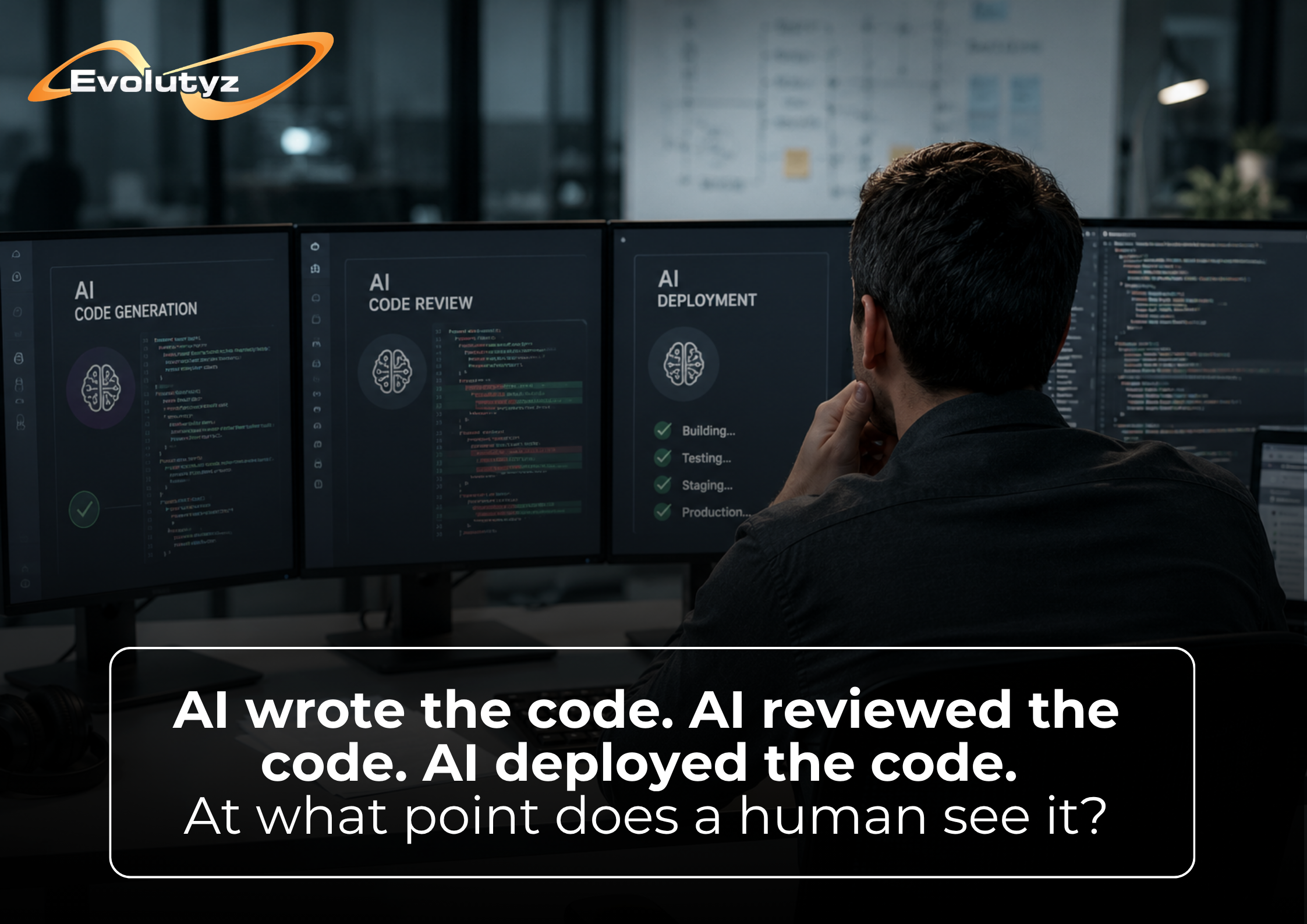
This raises an important question that extends far beyond productivity. If AI is generating the code, reviewing the code, testing the code, and deploying the code, where does meaningful human oversight actually exist?
Automation is no longer limited to repetitive tasks
For years, automation focused on eliminating repetitive, rule-based work. Continuous integration reduced manual builds, automated testing replaced repetitive regression cycles, and deployment pipelines minimized operational effort. These technologies enhanced productivity while leaving strategic decisions firmly in human hands.
Artificial intelligence is fundamentally different because it doesn’t just automate execution. It increasingly participates in decision-making. AI coding assistants recommend implementation approaches, AI reviewers determine whether code meets quality standards, and AI-powered security tools prioritize vulnerabilities based on perceived risk. These are no longer simple mechanical processes; they are decisions that influence how software is built and released.
Individually, each layer of automation provides clear value. Collectively, however, they reduce the number of moments where engineers naturally pause to question assumptions, validate context, or challenge recommendations. Over time, software delivery risks becoming a sequence of automated approvals rather than a collaborative engineering process.
Technical accuracy cannot replace human judgment
One of AI’s greatest strengths is its ability to identify patterns across vast amounts of data. It can detect inefficient code, recognize common vulnerabilities, recommend optimizations, and enforce coding standards with remarkable consistency. These capabilities make it an invaluable engineering assistant.
However, software development has never been solely about writing technically correct code. Every feature exists to solve a business problem, improve a customer experience, or support an organizational objective. Deciding whether a feature should exist, whether it aligns with customer expectations, or whether it introduces ethical, regulatory, or operational risks requires an understanding of context that extends well beyond the code itself.
An AI model can determine whether a function performs efficiently, but it cannot fully understand why a business chose one customer workflow over another or how a seemingly minor change could influence long-term product strategy. Technical correctness is only one component of software quality. Context, intent, accountability, and business impact remain equally important.
The real challenge is not unreliable AI but unquestioned AI
Much of the public discussion surrounding AI focuses on the possibility of incorrect outputs or hallucinations. While these are legitimate concerns, a more subtle risk is beginning to emerge inside engineering organizations.
As AI consistently produces useful results, teams naturally become more comfortable relying on its recommendations. Code reviews become shorter because automated reviewers have already highlighted potential issues. Manual testing decreases because AI-generated test suites achieve high coverage. Security scans become trusted by default because they rarely miss known vulnerabilities. None of these decisions are inherently wrong, yet together they create an environment where fewer people actively examine the software before it reaches production.
This gradual shift from verification to assumption is difficult to notice because it develops incrementally. Trust is earned one successful deployment at a time until eventually the organization begins trusting the process more than it understands the outcome.
Human oversight needs to evolve rather than disappear
The answer is not to reject AI or insist that engineers manually inspect every line of generated code. Modern software systems are too complex, and AI has already demonstrated its ability to improve productivity across nearly every phase of development.
Instead, organizations need to redefine what human oversight actually means. Engineers should spend less time correcting syntax, formatting code, or writing repetitive boilerplate, and more time evaluating architecture, validating business logic, identifying unintended consequences, and ensuring that technology decisions align with broader organizational goals.
Human expertise becomes increasingly valuable not because people are faster than AI, but because they provide judgment, accountability, and contextual understanding that cannot be derived from training data alone.
The future belongs to organizations that balance automation with accountability
As AI capabilities continue to mature, coding assistance, automated testing, intelligent code reviews, and autonomous deployment will become standard across the software industry. These technologies will eventually become baseline expectations rather than competitive differentiators.
The organizations that gain the greatest long-term advantage will not simply be those that automate the most processes. They will be the ones that establish clear governance around where human decision-making remains essential. Rather than viewing AI as a replacement for engineering expertise, successful companies will treat it as a force multiplier that allows people to focus on higher-value decisions while maintaining ownership of the final outcome.
The future of software development is unlikely to be defined by how much code AI can generate. It will be defined by how thoughtfully organizations combine automation with human accountability.