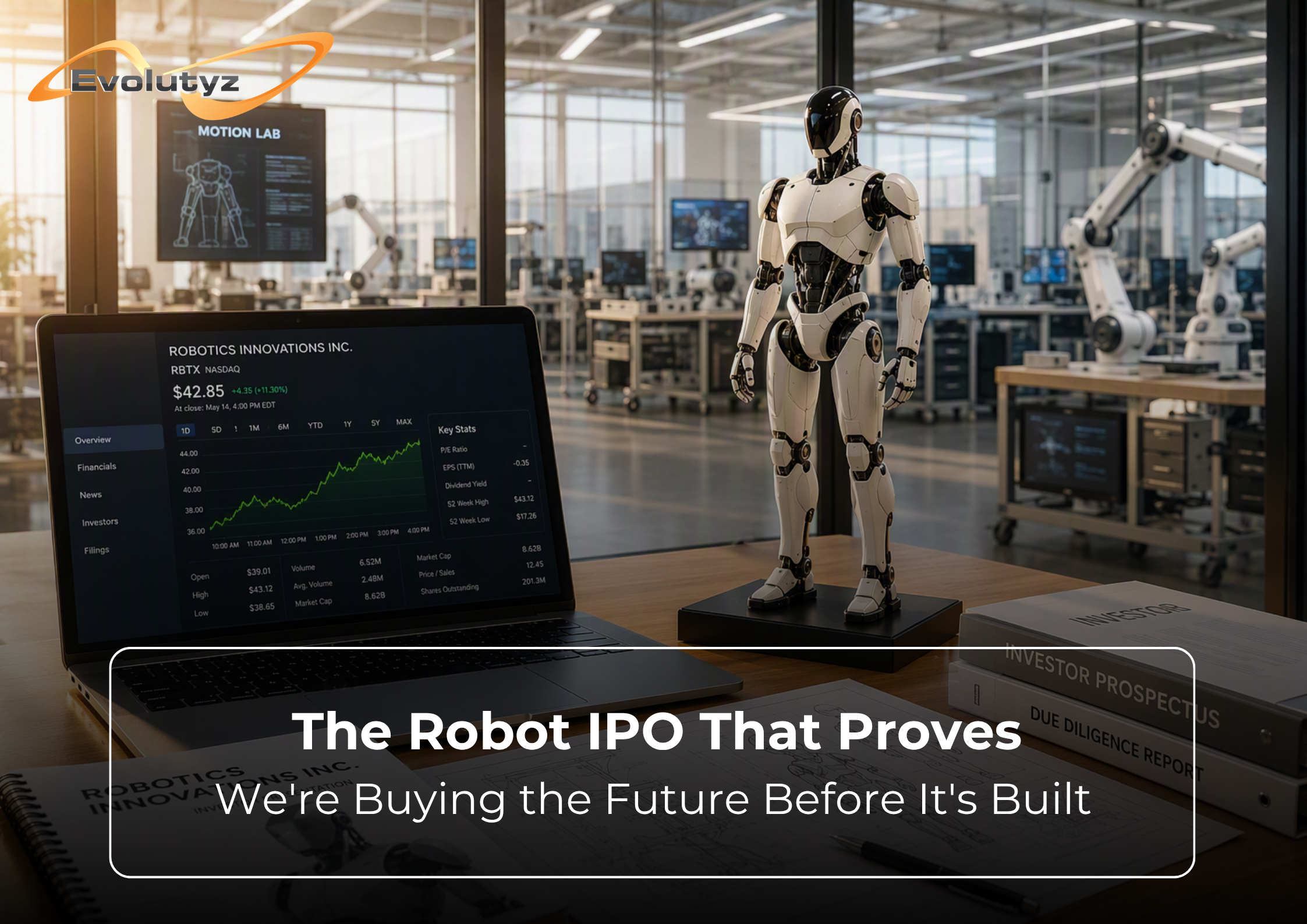
A robot company went public. Its stock price shot up more than sixfold in minutes. Almost none of the people buying it own a robot. So what were they paying for?
A Very Strange Wednesday Morning
On August 19, 2026, shares of a Chinese robot maker called Unitree started trading on the Shanghai stock market. Just before that, the company had set its share price at 150.80 yuan.
When trading opened, the price was 1,100 yuan.
That’s 629% higher, before lunch. The company’s value went from about $9 billion to briefly more than $60 billion. Nothing about the business changed in that window. No new factory. No new customer. The robots were exactly the same robots.
So what changed? People’s imagination.
First, the Facts
Here’s what happened, in plain terms:
-
The price: Unitree set its price at a value of about $9 billion and sold 10% of the company to raise around $900 million.
-
The demand: Buyers wanted shares about 8,000 times over. Imagine 8,000 people queuing for every single ticket to a concert.
-
The debut: The stock opened up 629% and finished the first day up 460%.
-
The comedown: A few days later, it was reported to be down 44% from its highest point.
One company, one week, and a valuation that swung like a pendulum.
Why did the Price Jump So Much?
Two reasons, and only one of them is about robots.
Reason one: very few shares were available. On day one, only about 7% of the company’s shares could actually be bought and sold. When lots of people want something and there’s hardly any of it, the price shoots up. It’s the same reason a limited-edition sneaker sells for triple its retail price the moment it drops.
Reason two: people are excited about what robots could become. And that’s the interesting part.
What Unitree Actually Sells (and how it’s doing)
This isn’t a company with only a fancy video and a dream. Unitree sells real robots to real customers.
In 2025, its revenue more than quadrupled to about 1.7 billion yuan. Humanoid robots (the ones with two arms and two legs) brought in around 868 million yuan of that, becoming its biggest product line.
That’s impressive. But there’s a second half to the story. Early this year, sales kept growing, yet the company’s profit dropped by more than half because it was spending heavily on research and marketing. The stock’s price at the IPO was over 200 times what the company earned the year before.
Think of it like this. If a small café earns $50,000 a year in profit, a price of 200 times that would value the café at $10 million. Someone paying that isn’t buying the café. They’re buying the idea that it could become a global chain.
That’s what happened here. The market wasn’t valuing today’s robots. It was valuing tomorrow’s.
Buying a House From the Blueprint
There’s a familiar version of this in everyday life. Sometimes people buy a flat before the building exists. They’re handed a brochure, a floor plan and a promise. It can work out very well. Or the project can run late, cost more, or come out different from the drawing.
Investing in humanoid robots right now is a bit like that. The builders are real. The plans are impressive. But the finished building, robots that work reliably in millions of homes and workplaces, is still years away.
And the same thing is happening well beyond Unitree:
-
A US robotics start-up called Figure raised over $1 billion at a $39 billion valuation. Analysts estimate that it shipped only around 150 robots in 2025. That works out to more than $250 million of company value for every robot sold.
-
Another US robot maker, Agility Robotics, is going public through a deal valuing it at about $2.5 billion, with paying customers already using its warehouse robots.
-
Companies in Texas, Europe and China have each raised hundreds of millions, and in some cases over a billion, in just the past year.
The numbers are all over the place. That’s because nobody has agreed yet on what a robot company is actually worth. Is it a machine maker? A software company? A future workforce partner? Each answer gives a very different price tag.
This has Happened Before
Whenever a big new technology shows up, the world tends to get excited early. It happened with railways, electricity, the early internet, smartphones and cloud computing.
In every case, two things turned out to be true at once:
-
The technology was real and changed the world.
-
Many of the early prices were too high, too soon.
Both can be true for robots too. Being right about the future doesn’t automatically mean being right about the price.
Where the Real Value is Hiding
Here’s the part that matters most, especially for anyone building or using technology.
A robot that can walk across a stage is a demo. A robot that can join a busy warehouse, learn how that specific place works, stay safe around the people nearby, and report how it’s performing is a product.
Look at what fills that second list: software, data, safety design, and the connections between different systems. It’s the behind-the-scenes work that turns something impressive into something dependable.
And notice what these robots are actually built for. Not replacing people, but sharing the load: lifting heavy boxes, repeating the same motion thousands of times, working the awkward shifts. That frees people up for the parts of a job that need judgment, creativity and care. The robots that succeed will be the ones designed to work with people, not around them.
So the big winners in this space may be the companies that make robots useful, not just the ones that make them walk.
Five Questions to Ask about any Robot Company
Next time a headline says a robot stock is soaring, skip the price and ask these instead:
-
Are customers coming back? One pilot robot is a test. A hundred reorders is a real business.
-
Does each robot keep earning? A machine that pays for itself month after month beats one that only sells once.
-
Is the company making money on each sale? Big sales with thin profit can be a warning sign.
-
How much income comes from software and services? The more it comes from smart features rather than metal, the stronger the long-term picture.
-
What happens when more shares open up for trading? Early excitement gets tested once more people are allowed to sell.
The robot IPO is a mirror. It shows a world so keen on the next big thing that it will pay for it before it’s finished.
That isn’t crazy. Big ideas need early believers to get built. But there’s a big difference between backing a future and assuming it has already arrived. The gap between those two is where the smartest bets, and the costliest mistakes, get made.
The technology is real. The price is a story. And the interesting part is watching which one catches up with the other.