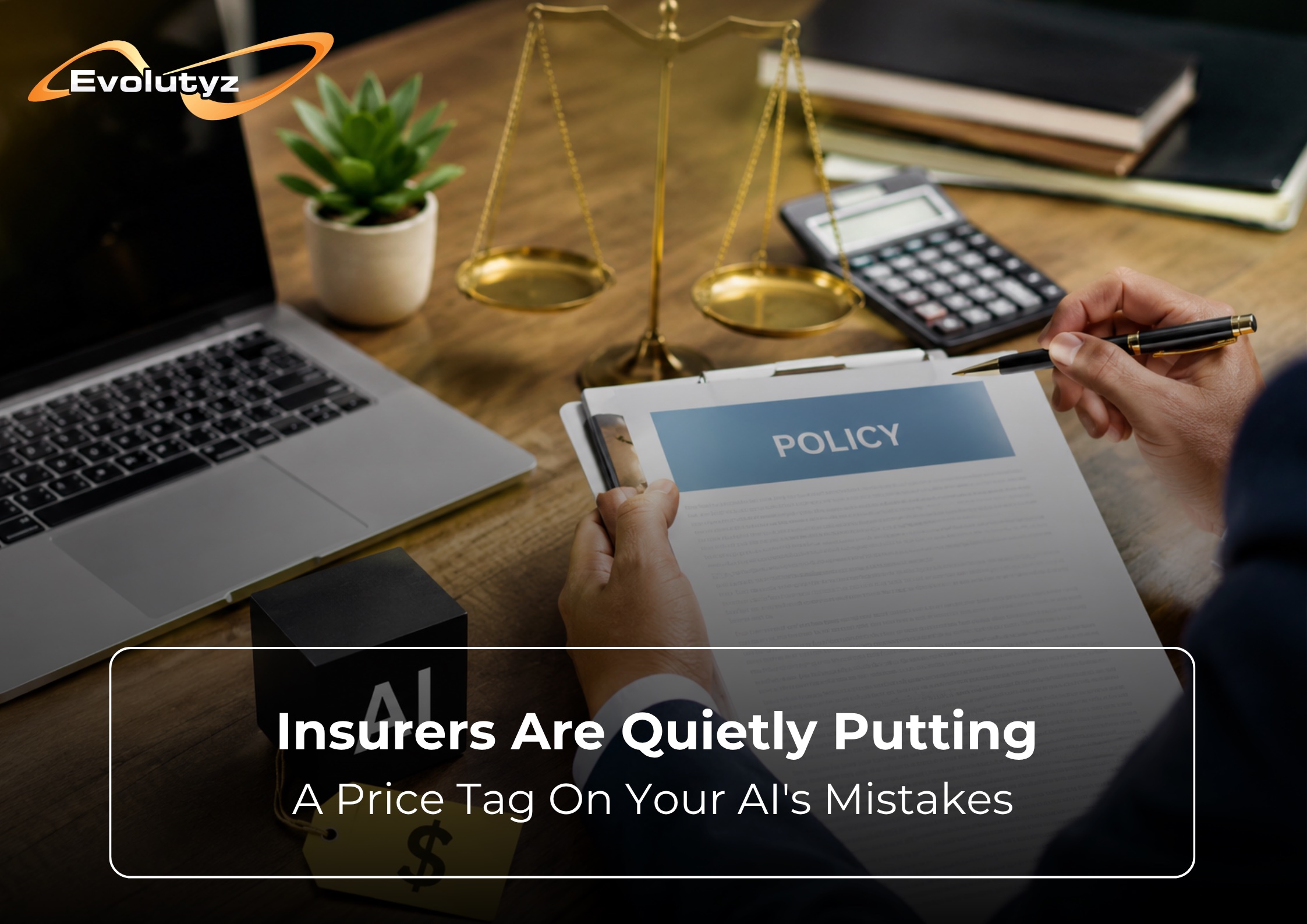
“The AI did it” is the new “the dog ate my homework.” Except now it comes with a policy exclusion.
Imagine your chatbot promises a customer a 90% discount. Or invents a quote and attributes it to a real person. Or writes a product description that borrows a little too heavily from someone else’s work. You call your insurer. They ask one question: “Was AI involved?” If the answer is yes, 2026 might have a surprise waiting for you.
The Era of “Silent AI” is Over
For years, business policies never mentioned AI at all. No exclusion, no coverage, just silence. So if an AI tool caused a loss, the claim was usually treated like any other software slip-up.
That silence ended on January 1, 2026, when the Insurance Services Office rolled out three generative AI exclusion endorsements for general liability policies (CG 40 47, CG 40 48 and CG 35 08). They are optional, but they gave insurers a ready-made template, and the market took the hint.
Since then:
- Berkley introduced an absolute AI exclusion across its D&O, E&O and fiduciary liability products.
- Chubb, Travelers and Berkshire Hathaway reportedly sought regulatory approval to carve AI-related damages out of general liability policies.
- Beazley and QBE went for the middle path: AI sublimits sitting at roughly 10% of overall cyber policy limits.
That last one is the quiet headline. Your AI risk now has its own, much smaller, wallet.
What Counts as “An AI Mistake”?
More than you would think. The exclusions touch defamatory content, IP infringement from AI-generated material, and even physical harm traced back to an AI-driven error.
And the “we didn’t say that, the bot did” defence is not holding up well. In a well-known case, an airline was made to honour a refund policy its own chatbot invented. The tribunal’s view was simple: the chatbot is part of your website, so what it says is on you.
Insurers are borrowing that logic. If your AI said it, you own it.
The Plot Twist: AI is not Uninsurable
Before anyone panics, insurers are not saying AI cannot be covered. They are saying it should be priced on purpose, not by accident.
The same industry pulling AI out of standard policies is building standalone products to put it back in, with a price tag attached. Munich Re and a wave of specialist startups now sell dedicated AI liability cover. HSB, a Munich Re company, launched one aimed at small and mid-sized businesses that stretches to situations like a mispriced AI quote you are forced to honour. AXA XL added generative AI cover by endorsement to its cyber policies.
The pattern is familiar. Cyber risk went through the same cycle: carved out of old policies first, then rebuilt as its own product.
The part Nobody Puts in the Headline
The price of that new cover is increasingly set by how you govern AI, not just whether you use it.
Two companies can run the exact same chatbot and get very different quotes. The one that can show its homework wins. Underwriters are starting to ask things like:
- Who reviews AI outputs before they reach a customer?
- Is there a log of what the AI said and did?
- Where does a human step in when something looks off?
- Did you check how your AI vendor handles data, security and liability?
Notice what is missing from that list: “How much AI do you use?” Nobody is penalising ambition. They are rewarding teams that keep people in the loop and receipts in the drawer.
Your 15-minute Homework
- Read your renewal. Ask your broker to scan your GL, E&O, D&O and cyber policies for AI endorsements or “arising out of” language.
- Ask about standalone cover. It may be cheaper than the gap.
- Write down your AI rules. Who approves, who monitors, who can hit pause.
- Audit your vendors. If a tool touches customers, know what happens when it gets something wrong.
AI mistakes used to be an awkward email. Now they are a line item. The businesses that will sleep best are not the ones that avoid AI, but the ones that can show exactly who is steering it.
Because when the claim form asks “who was responsible?”, “the algorithm” is not an answer anyone will pay out on.