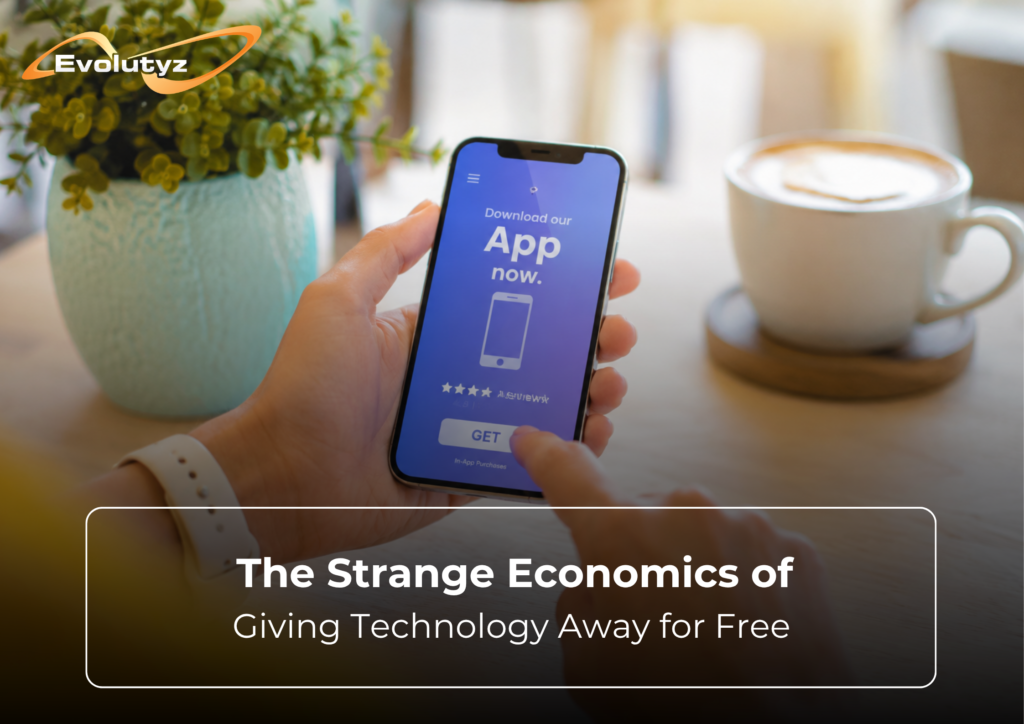
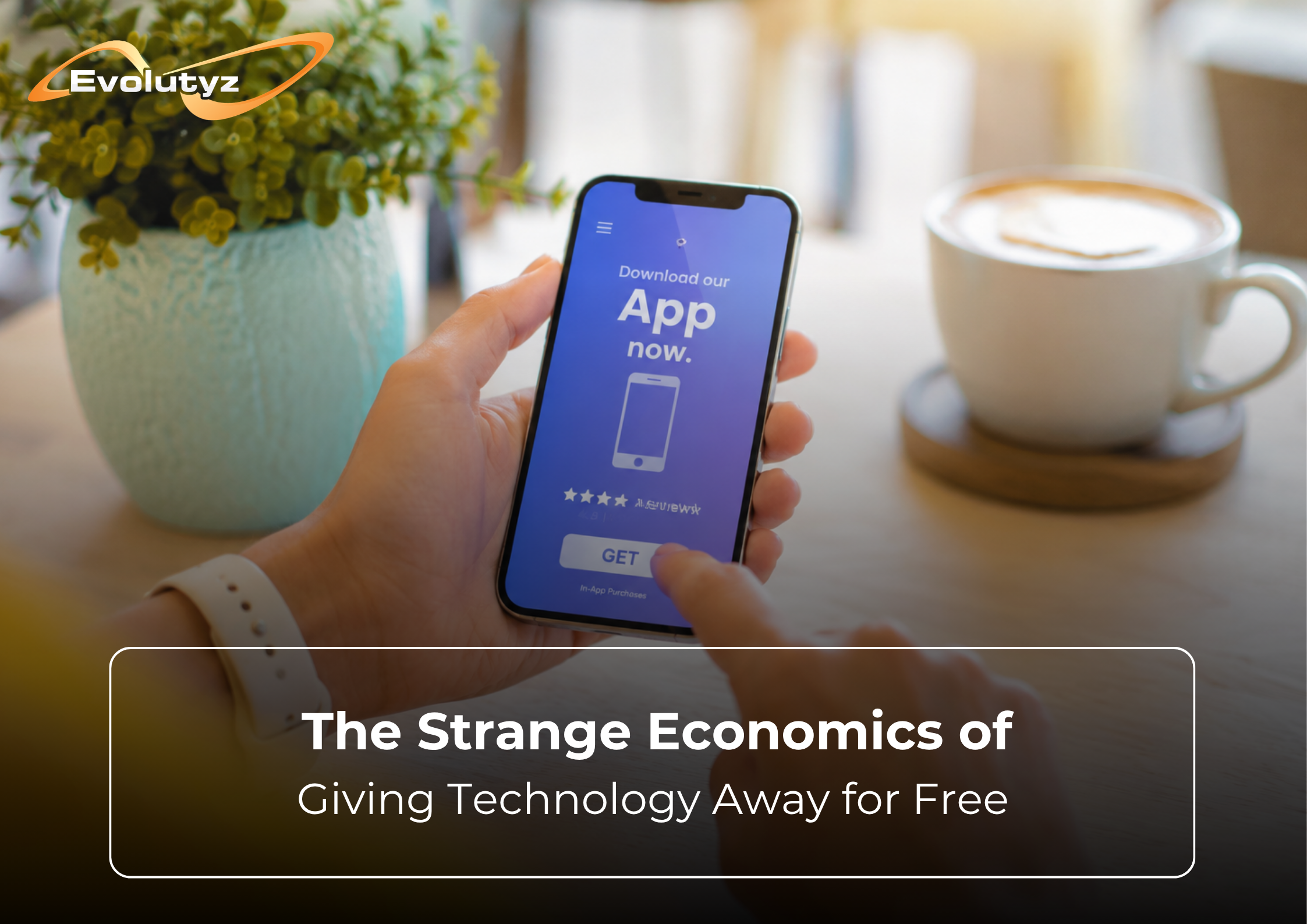
Look at the bottom of almost any app download screen and you will find a tiny line of grey text: In-App Purchases. It sits right under the big friendly GET button, and it is quietly doing more work than the entire app.
That little label is the business model. The download is free. The money shows up later, somewhere else, from someone else, in a form you may not have noticed.
This is one of the oddest facts about the technology industry. Some of the most valuable companies on earth built their fortunes on products that most of their users have never paid a rupee, dollar or euro for. Search, maps, email, video, messaging, operating systems, code editors, entire programming ecosystems. Free, free, free.
So how does giving things away make anyone rich? And what happens to that model now that AI has arrived and every free answer has a real cost attached?
Free is not the Absence of a Price
The first thing to unlearn is that “free” means “nobody is paying.” Somebody always pays. Free is a pricing decision about who pays, when they pay, and for what.
Once you see it that way, nearly every free technology product falls into one of four patterns:
-
Someone else pays for your attention (advertising).
-
A small slice of users pays for everyone else (freemium).
-
Free is a weapon aimed at a competitor or a market (open source and platform plays).
-
Free is the front door to a much bigger bill later (lock-in).
But before the four patterns, there is the reason any of this is possible at all.
The trick Underneath: Software is Absurdly Cheap to Copy
If a bakery gives away free bread, it goes bankrupt by Friday. Every loaf costs flour, electricity and labour.
Software plays by different rules. Building the first copy can cost millions. Building the second copy costs almost nothing. Serving one more person a webpage or an app update costs a fraction of a fraction of a cent. Economists call this near-zero marginal cost, and it is the foundation under the entire free technology economy.
When the cost of serving one more user is close to nothing, the real question flips. It stops being “how do we charge for this?” and becomes “what is the most valuable thing we can do with a few hundred million users who cost us almost nothing?”
That question has produced four very different answers.
Pattern 1: You are the Inventory (Advertising)
The most famous free model is also the most misunderstood. You have probably heard the line, “If you’re not paying, you’re the product.” It is catchy, and it is roughly half right.
A more accurate version: your intent and your attention are the product. Search is the cleanest example. When someone types “best running shoes under 5000” into a search box, they are telling the world they are about to spend money. An advertiser will happily pay to appear in that exact moment. The search engine did not need to charge the person asking. It only needed to be so useful that billions of people asked.
The numbers show how lopsided this gets. For both Google’s parent company and Meta, advertising makes up the overwhelming majority of revenue, with Meta’s share running at well over ninety percent. The “free” products are the delivery mechanism. The ad business is the company.
There is a second, stranger layer to this. Free products also pay each other. Search companies have paid enormous sums, reported in the tens of billions of dollars a year, to be the default search option on browsers and phones. A free service buying distribution for another free service, so that both can keep selling ads. That is not a side deal. That is the economy.
Pattern 2: The Few Who Pay for the Many (freemium)
Freemium sounds generous. Underneath, it is a carefully tuned machine built on a humbling statistic: in most freemium products, only a small single-digit percentage of users ever convert to paying.
That sounds like a failure. It is actually the design.
Think about what the other ninety-something percent of free users do for the business:
-
They are the marketing department. Free users invite colleagues, share links, write reviews and mention the tool in group chats.
-
They are the network. A messaging or collaboration tool with ten users is useless. With ten million it is a utility. Free users make the product worth paying for.
-
They are the testing lab. Every click, rage-quit and abandoned setup flow teaches the product team what to fix.
-
They are the future paying customers. Someone who uses a free tier as a student may become the person who signs the team subscription five years later.
The real craft is in the limit. A free tier has to be good enough that people fall in love with it and restrictive enough that growing users hit a wall at exactly the moment they would happily pay to cross it. Storage caps, export limits, team size, history length, advanced features. Where that wall stands is not a technical decision. It is the most important pricing decision the company makes.
Get it wrong in one direction and nobody ever upgrades. Get it wrong in the other and nobody ever sticks around long enough to care.
Pattern 3: Free as a Weapon (open source and commoditizing the neighbour)
This is where the economics get genuinely strange, because the company giving the product away is not selling ads or chasing upgrades. It is reshaping the market around its real product.
The strategy has a name in business circles: commoditize your complement. Your product has complements, the things customers need alongside it. If those complements get cheap, demand for your product rises. So you make the complement free.
A few real examples:
-
Android is free for phone makers to use. That keeps handset prices low, grows the number of people online, and sends those people straight into search, maps and an app store. The operating system is the gift. The ecosystem is the payoff.
-
Open source infrastructure like Linux and Kubernetes is built and maintained by competing giants who all benefit from a shared, free foundation, then compete on the services built on top of it.
-
Free developer tools are not charity either. A free code editor that millions of developers adopt pulls those developers toward the cloud services and platforms that sit around it.
-
Open AI frameworks and open-weight models let companies set the standards, attract talent, and make sure no single rival controls the layer everyone else depends on.
The pattern is consistent. Free is not what is being sold. Free is what is being spent to make something else more valuable.
Pattern 4: The free sample with a long shadow (lock-in)
The fourth pattern is the most patient. Cloud providers hand out generous free credits and free tiers to startups and students. Nobody is being foolish. The provider is betting on data gravity.
Once your application, your database and your files live somewhere, moving them becomes painful. Your team knows one set of tools. Your integrations are wired to one platform. Pulling your data back out can come with its own fees. The free credits were never the price. They were the first step on a staircase that is very easy to climb and very awkward to descend.
Switching costs are the invisible bill attached to many free products. You only see it when you try to leave.
The Plot Twist: AI Breaks the Old Math
Here is where it gets interesting for 2026.
Everything above worked because serving one more user cost almost nothing. Generative AI quietly broke that assumption.
When someone opens a search page, the response is cheap. When someone asks an AI model to write, reason or generate an image, a lot of expensive hardware does real work. Specialized chips run hot, data centers draw serious power, and every long, thoughtful answer carries a genuine cost. For the first time in decades, a free tier of a software product has a real marginal cost per user, and heavy users can cost far more than light ones.
That changes the strategy in several ways:
-
Free AI is increasingly a loss leader. It is subsidized by investor money, by enterprise contracts, and by bets on future revenue, not by the free user themselves.
-
Limits are getting tighter and smarter. Expect usage caps, slower queues, lighter models for free users and the best models behind a paywall. The free tier is no longer “the same product, fewer features.” It is often a genuinely different, cheaper engine.
-
Smaller models matter more. The race to make capable models cheaper to run is not just a research flex. It is how a company makes a free tier survivable.
-
Advertising may follow. Where a free product costs real money to run, the old ad model becomes very tempting, and the industry is already experimenting with how to make it work.
-
Open models change the pressure. When capable open models are available to anyone, paid products have to prove they are worth paying for, which pushes prices down and quality up.
In other words, the oldest trick in tech, “give it away and monetize later,” now has a meter running in the background.
What Free Costs the People Using It
Free is rarely free for the user. It just changes currency.
-
Data. The product is funded by what it learns about you.
-
Attention. Your time is the thing being sold, which is why free products are engineered to keep you scrolling.
-
Dependency. Free products can be changed, limited or shut down overnight, and people who built their workflow on them find out the hard way. A free tool you rely on is a tool you do not control.
-
Exit costs. The more you put in, the harder it is to leave.
None of this means free products are bad. Many of them are genuinely excellent, and billions of people get real value from them. It means the smart question is never “is it free?” The smart question is “what am I paying with?”
What Product Teams Can Take From all This
For anyone building technology, free is a powerful tool and a dangerous habit. Before putting a free tier into the world, it helps to answer five questions honestly:
-
Who actually pays, and why would they? If the answer is “eventually, somehow,” there is no model yet.
-
What does one free user really cost? Especially with AI features, this number is no longer close to zero.
-
Where is the upgrade moment? The best limits sit exactly where a user’s success begins to outgrow the free plan.
-
What is the free tier doing for the business? Marketing, network growth, data, distribution and standards are all valid answers. “Nothing” is not.
-
What happens if every competitor does the same? If free becomes the baseline, the advantage has to come from somewhere else.
Free technology is not generosity, and it is not a trick. It is a bet that something else will be worth more than the price you chose to forgo: attention, scale, standards, loyalty, data or time.
The companies that win with free are the ones who know exactly what they are really selling. The users who win are the ones who know it too. So the next time a GET button asks for nothing, read the line beneath it. That is where the real price tag lives.