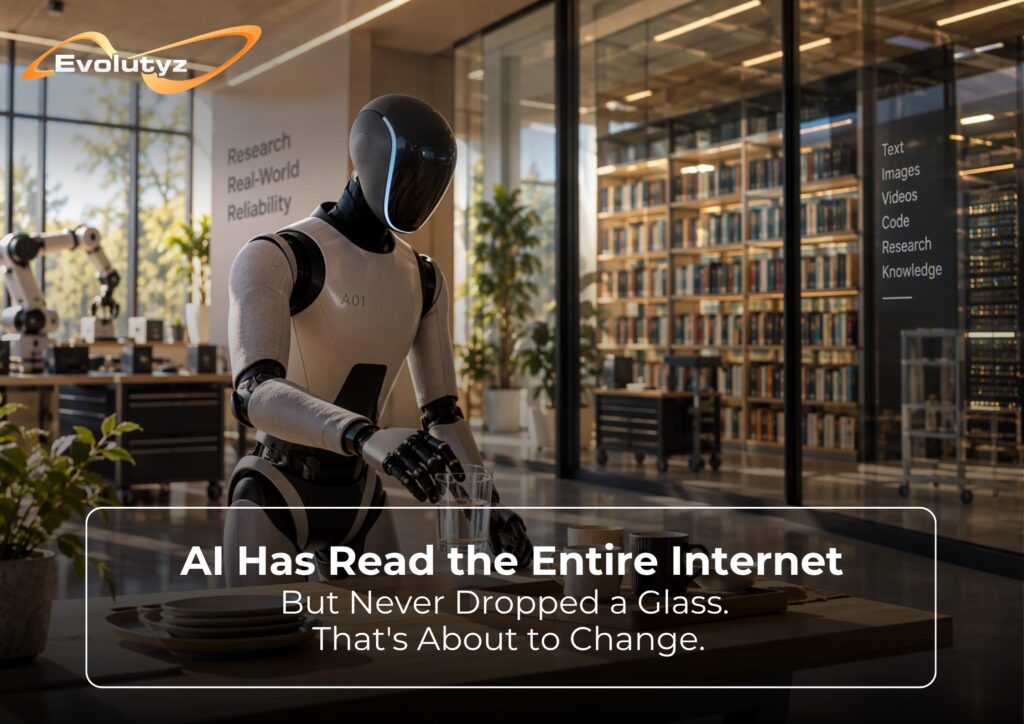
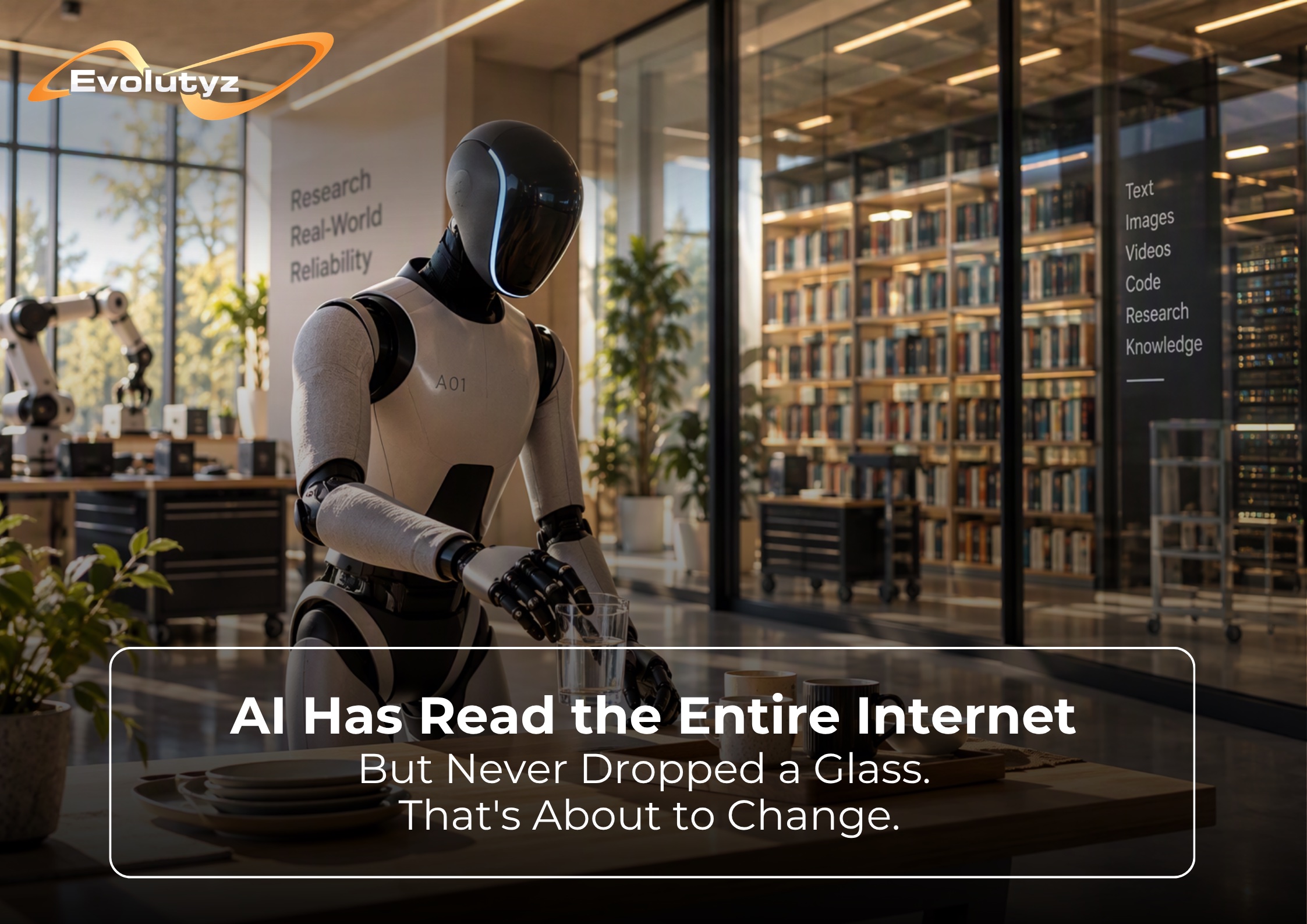
The Internet has No Chapter on Gripping Things
Modern AI learned from an absurd amount of text, images, videos and code. Decades of people typing, posting, explaining and arguing about everything. That’s why it sounds like it has read it all. In a way, it has.
But nobody ever wrote down what a glass feels like. The internet is a record of what people think and say. It holds almost nothing about what hands know: how hard is too hard, how slippery wet ceramic gets, how a mug shifts when someone pours tea into it. That knowledge lives in the body, not in the text.
A Glass is a Robot’s Worst Nightmare
Look at the humble glass from a machine’s point of view:
- It’s transparent, so cameras struggle to tell where it starts and ends.
- It’s slippery, especially once condensation shows up.
- It’s fragile, so one squeeze too many and it’s over.
- Its weight keeps changing, the moment someone fills it.
A human handles all four without a flicker of thought. Your fingertips sense a slip a split second before it happens and your grip adjusts on its own. A robot has to learn every bit of that from scratch.
The Paradox that Explains Everything
Researchers noticed this oddity decades ago, and it even has a name: Moravec’s paradox. The things we call “hard” (chess, maths, logic) turn out to be easy for computers. The things a toddler does without trying (grasping, stacking, walking across a messy room) are brutally hard.
A computer beat the reigning world chess champion back in 1997. Yet a robot that can reliably empty any dishwasher in any kitchen is still a work in progress. The reason is almost poetic. Evolution spent hundreds of millions of years fine-tuning movement and touch. Abstract reasoning is a recent add-on. What feels effortless to you is the result of an enormous head start.
The Toddler Test
Here’s a humbling thought. A two-year-old who can’t spell their own name can still pour juice into a cup, mostly without spilling it.
How? Not by reading a manual. By dropping things. Thousands of times. Toddlers run tiny experiments all day: push the cup, tilt the cup, drop the cup, watch what happens, adjust. Every failure is data, and every spill sharpens the next attempt. That loop of try, fail, feel, adjust is exactly what machines have been missing. They’ve had the library. They haven’t had the playground.
The Data Problem Nobody Talks About
Text is easy to collect. The internet handed AI trillions of words for free. Physical experience is not. There is no “internet of touch” to scrape.
Every robot grasp has to be recorded in the real world, in real time, with a real object that can really break. It’s slow and expensive, and it doesn’t scale the way copy-pasting a webpage does.
So researchers are getting creative. People teleoperate robots to show them how a task is done. Wearable gloves capture how human hands move. Cameras record everyday chores so machines can study them. It’s less “read everything online” and more “learn an apprenticeship, one task at a time.”
So Why is this About to Change?
Three shifts are closing the gap.
Models that connect seeing, understanding and doing. A new class of models takes in a camera feed plus a plain-language instruction, like “move the glass onto the tray”, and produces the actual movements. No hand-coded steps for every single scenario.
Practice at impossible scale. Robots can attempt millions of grasps in simulated worlds before touching a real object. The catch is the gap between simulation and reality, which is exactly why real-world testing has become the main event.
Better touch, shared learning. Fingertip sensors are getting more sensitive, and fleets of robots can pool what they learn. A person learns to hold a glass once, for themselves. When one robot drops a glass, every robot in the fleet gets the lesson.
Where You’ll See it First
Don’t expect a robot butler pouring your morning water next year. The early wins will be quieter and more practical.
Think warehouses, where machines handle sorting and carrying so people avoid the heaviest lifting. Labs, where robots repeat delicate procedures the same way every single time. Hospitals, where an extra pair of steady hands can fetch supplies and free up staff for patient care. Factory floors, kitchens, and eventually homes.
The pattern is the same everywhere: start with the repetitive, narrow and predictable, then widen the circle as reliability improves.
What this Means for Businesses
Physical AI is not about replacing people. It’s about taking over the repetitive, heavy and risky parts of a job, so people can spend their time on judgment, creativity and care.
But the hard part is rarely the robot’s body. It’s everything around it: data pipelines, safety checks, testing, monitoring and reliability. A system that works 95% of the time makes a great demo and a terrible colleague. A glass dropped in a lab is a lesson. A glass dropped in a hospital is an incident. That gap between “it worked once” and “it works every day” is where the real engineering lives.