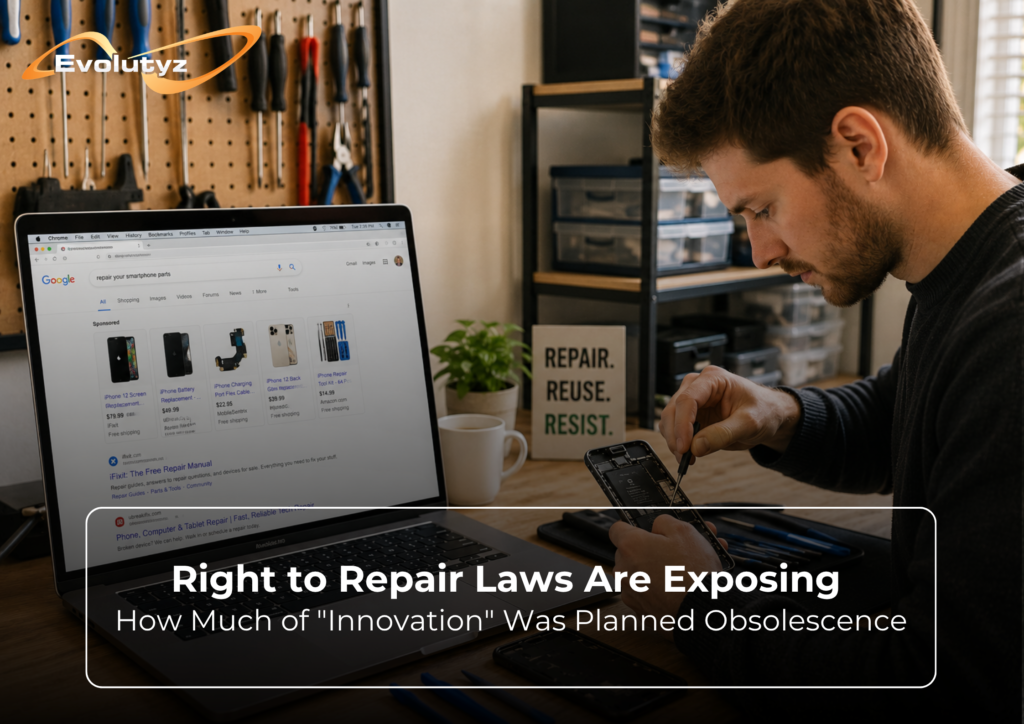
For years, the pitch was simple. Your phone slows down because technology moves fast. Your laptop battery dies because batteries just do that. Your appliance can’t be fixed because it’s “not built that way anymore.” Every generation of devices arrived faster, thinner, smarter, and somehow also more disposable, and we accepted that as the price of progress.
Then Right to Repair laws started passing, manufacturers started getting subpoenaed for their repair policies, and internal documents started surfacing. Turns out a lot of what got sold as inevitable technological progress was, in plenty of cases, a business decision.
What Right to Repair actually forced open
Right to Repair legislation, now active in a growing number of US states and the EU, requires manufacturers to make repair manuals, parts, and tools available to consumers and independent repair shops, not just their own authorized service centers. On paper, that sounds like a parts availability issue. In practice, it forced companies to explain, sometimes in court, why a battery replacement needed a serial-number-matched part, why a “genuine parts” warning would appear after a third party repair, or why software updates seemed to correlate suspiciously well with degraded performance on older models.
Once those explanations had to hold up to scrutiny instead of just marketing copy, some of them didn’t.
The performance slowdown that had a name
The clearest public example: a major smartphone maker was found throttling processor performance on older phones with aging batteries, initially without telling anyone. The stated reason was to prevent unexpected shutdowns as batteries degraded. That part was true. What wasn’t communicated was that the fix wasn’t “replace an aging battery,” it was “quietly slow down the whole phone,” which conveniently also made a new phone feel like a more attractive option. The company was fined in multiple countries once regulators dug in, and it started offering discounted battery replacements as a direct result of the backlash.
That’s the pattern Right to Repair keeps surfacing. Not a single evil switch, but small design decisions, glued-in batteries, proprietary screws, parts pairing between components, that individually look like engineering choices and collectively look like a repair funnel back to the manufacturer.
“Parts pairing” is the quiet version of the same idea
A newer pattern showing up in right-to-repair fights is parts pairing, where a device’s software checks whether a replacement part, a screen, a battery, a camera module, is “authorized,” even if the physical part is functionally identical. Install a perfectly good third-party or salvaged part, and the device may throw persistent warnings, disable features, or simply refuse to fully recognize it. Some manufacturers argue this is a security and quality control measure. Right to Repair advocates argue it’s a way to make independent and self-repair frustrating enough that people give up and go through official channels instead. Regulators in several jurisdictions have started asking manufacturers to justify parts pairing rather than just permit it.
Why this matters beyond phones
This isn’t only a consumer electronics story. Tractors are one of the most cited Right to Repair battlegrounds in the US, with farmers reporting they couldn’t fix their own equipment without a manufacturer-authorized technician, sometimes waiting days during harvest season for a software unlock that a farmer could have handled in an afternoon with a diagnostic tool they weren’t allowed to have. Medical equipment, wheelchairs, and hospital devices have had similar fights, where hospitals couldn’t repair their own ventilators during a crisis without vendor sign-off.
The through-line across every one of these industries is the same: repairability was technically possible. It just wasn’t made available, and the reasons given for that ranged from safety to IP protection to quality assurance, some legitimate, some doing a lot of convenient double duty as a revenue channel.
What this means for how “innovation” gets sold
None of this means every hard-to-repair product is a scam, or that every design choice restricting repair is malicious. Waterproofing, miniaturization, and battery energy density genuinely do make some repairs more difficult as an honest engineering trade-off. That’s real.
But Right to Repair has done something valuable regardless: it’s made “that’s just how technology works now” a claim that has to be proven, not just stated. When a company has to publish a repair manual, price out individual parts, and explain a software lockout to a regulator, the difference between an actual engineering constraint and a business strategy dressed up as one becomes a lot easier to see.
The interesting part isn’t really the fines or the lawsuits. It’s that Right to Repair has quietly changed what customers expect to be told. “It’s not repairable” used to be an acceptable final answer. Now it’s a question that gets a follow-up: says who, and why not. That’s a small shift in a warranty policy, and a much bigger shift in how much scrutiny “innovation” has to survive before people believe it.